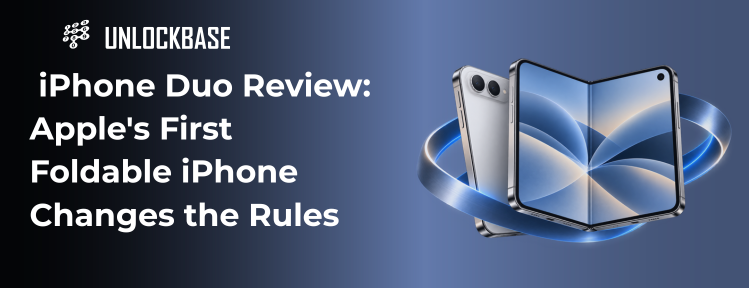
Apple’s arrival in the foldable smartphone category marks an important change in the premium mobile market. This iPhone Duo review examines what Apple’s first foldable means for smartphone buyers, how its design compares with established alternatives, and which questions matter before committing to a new form factor.
Foldable smartphones are no longer experimental curiosities. Samsung and other manufacturers have spent years refining hinges, flexible displays, multitasking software and durability. Apple enters a category where consumers already have clear expectations—and where a premium price must deliver more than an impressive folding mechanism.
For potential buyers, the central question is whether the iPhone Duo offers enough practical advantages to justify choosing it over a conventional flagship.
Apple’s First Foldable iPhone: Why It Matters
Apple’s entry into foldables matters for reasons beyond the device itself.
The company has historically favored established product categories where it can combine hardware, software and ecosystem integration into a tightly controlled experience. Its approach to foldables will therefore be judged not only by engineering specifications but also by everyday usability.
A foldable iPhone has the potential to change how people use mobile applications, particularly when switching between compact and expanded screen configurations.
It also brings foldable hardware into an ecosystem where customers may already depend on iCloud, iMessage, FaceTime, AirDrop, Apple Watch and Mac continuity features.
For existing iPhone users who previously considered a foldable Android phone but hesitated to change platforms, the Duo introduces another option.
However, the arrival of an Apple foldable does not automatically make the format ideal for everyone.
The device still needs to justify its additional complexity, weight, cost and potential repair considerations.
Design, Hinge and Dual Displays
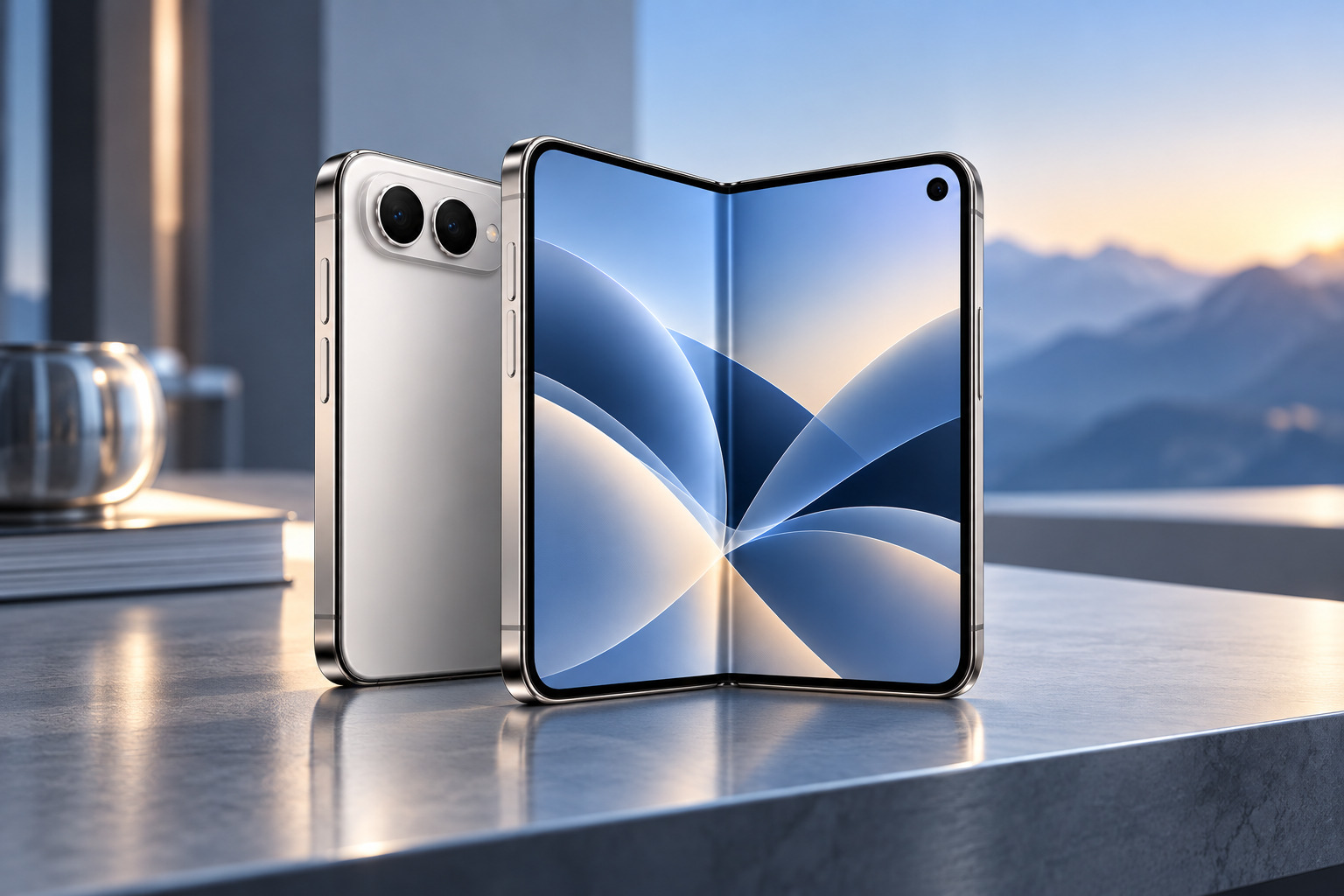
The defining feature of the iPhone Duo is its folding construction.
Unlike a conventional smartphone, which offers one primary display, a book-style foldable combines an exterior screen for quick interactions with a larger interior display for more expansive tasks.
That arrangement creates two distinct ways to use the same device.
The Outer Display: Everyday Convenience
A foldable’s exterior screen should handle the tasks people perform most frequently.
These include replying to messages, checking notifications, making calls, using maps, scanning boarding passes and taking quick photographs.
If the outer display feels too narrow or awkward, users may need to unfold the device unnecessarily.
A successful design therefore depends on making the closed phone genuinely useful rather than treating the exterior display as a secondary accessory.
The Inner Display: The Main Attraction
Opening the Duo creates more room for reading, editing documents, browsing websites and working across applications.
This is the strongest argument for a foldable phone.
A larger display can make detailed content more comfortable without requiring a separate tablet.
It can also improve productivity for people who frequently work from their smartphones.
However, screen size alone does not guarantee a better experience. Applications must adapt properly to the expanded format.
Hinge Durability and the Display Crease
A foldable introduces mechanical elements that conventional phones do not have.
The hinge must withstand repeated opening and closing, while the flexible display must tolerate bending over time.
Potential buyers should pay attention to independent durability testing, manufacturer warranty terms and repair costs.
A visible or tactile crease is another consideration.
Its practical importance depends on how noticeable it becomes during normal use, especially when reading, scrolling or watching videos.
The best evaluation comes from handling the phone in person rather than judging the crease from promotional photographs.
Performance, Multitasking and Software
The most important performance question for a foldable is not simply how quickly it opens applications.
It is whether the device uses its expanded display effectively.
Apple’s software integration will play a central role in the Duo’s appeal.
Switching Between Displays
A well-designed foldable should allow users to begin a task on the outer screen and continue on the inner display without interruption.
For example, someone might open an email while commuting and unfold the phone to review an attached document.
The transition should feel natural.
If applications reload unnecessarily or lose their position, the larger display becomes less useful.
Multitasking Expectations
A foldable offers enough physical screen space to make simultaneous applications more practical.
Useful scenarios include comparing travel bookings, reviewing a document while messaging a colleague, or consulting a calendar during a video call.
The quality of the experience depends on the multitasking features Apple actually provides and how third-party developers support them.
Buyers should verify which split-screen, window-management and application-continuity functions are available rather than assuming the Duo duplicates every capability found on an iPad or Android foldable.
Everyday Speed
For most users, modern flagship-level processing performance already exceeds what messaging, browsing, navigation and streaming require.
Sustained performance, heat management and battery efficiency are more meaningful differentiators.
The larger interior screen may encourage longer productivity sessions, so consistent performance matters more than an isolated benchmark result.
Camera System and Battery Life
Foldable phones face an unusual engineering challenge.
They must accommodate cameras, batteries, displays and hinge components within a body that folds.
This can create compromises compared with conventional flagship smartphones.
Camera Expectations
The iPhone Duo’s camera system should be evaluated according to real-world results rather than camera count alone.
Important questions include:
How well does the main camera handle challenging lighting?
Is the ultrawide camera consistent with the main sensor?
What optical zoom capabilities are available?
How effectively does video stabilization work?
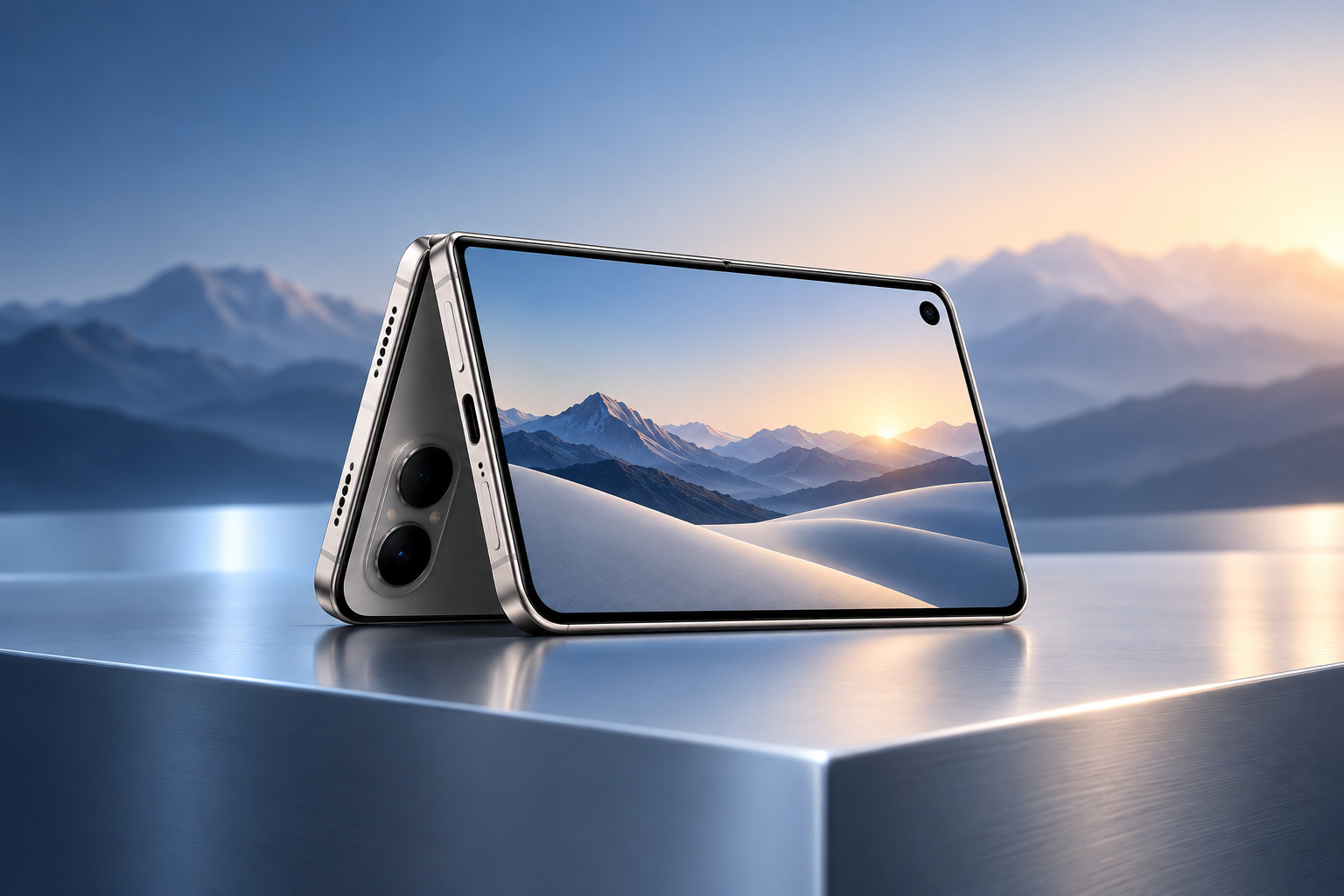
Can the folding design improve hands-free photography?
The last point is particularly interesting.
A foldable may allow the phone to rest partially open on a surface, potentially making certain photographs and video calls more convenient.
However, these advantages depend on the camera application and supported shooting modes.
Battery Life
Two displays do not necessarily operate simultaneously, but the larger interior panel can consume considerable power during extended use.
Battery endurance should therefore be assessed in two scenarios.
The first is ordinary smartphone use, primarily on the exterior display.
The second is heavier use of the interior screen for browsing, video, navigation and multitasking.
A device that performs well in the first scenario may deliver different results in the second.
Prospective buyers should look for independent battery testing that reflects how they actually intend to use the phone.
iPhone Duo vs Samsung Galaxy Z Fold 8
The most obvious competitor is Samsung’s Galaxy Z Fold 8.
Samsung has years of experience developing book-style foldable smartphones, while Apple brings its own ecosystem and software approach.
Key comparison points
Category
iPhone Duo
Galaxy Z Fold 8
Ecosystem
Apple’s iOS ecosystem
Samsung’s Android ecosystem
Main appeal
Foldable experience for iPhone users
Established Galaxy foldable experience
Multitasking
Depends on Apple’s Duo-specific implementation
Samsung’s established foldable multitasking approach
Accessories
Apple ecosystem integration
Galaxy ecosystem integration
Buying consideration
First-generation Apple foldable
Later-generation Samsung foldable
The decision should not rest entirely on which device has the larger display or more impressive specifications.
For existing iPhone users, remaining within Apple’s ecosystem may outweigh certain hardware differences.
For users who prioritize flexible multitasking, customization and established foldable workflows, Samsung may remain attractive.
The most useful comparison involves hands-on testing of application behavior, hinge comfort, battery endurance and repair terms.
Pricing, Availability and Carrier Compatibility
Foldable phones typically occupy the upper end of the smartphone market.
The iPhone Duo’s value proposition therefore depends on more than its purchase price.
Buyers should consider storage, insurance, repair costs, warranty coverage and the availability of compatible accessories.
A foldable may also be more expensive to repair than a conventional smartphone because of its specialized display and hinge construction.
Check the Exact Regional Model
International buyers should verify the model number and cellular specifications.
Devices sold in different markets can vary in SIM configuration, supported network bands and certain regional features.
The commercial name alone is not sufficient to establish compatibility.
Carrier Lock Status Still Matters
A premium device can still be subject to carrier restrictions when sold through a participating network.
Before buying a carrier-supplied iPhone Duo, check whether it is unlocked, whether financing or account conditions apply, and when the carrier permits unlocking.
An unlocked device offers greater flexibility when changing providers or using compatible travel connectivity.
However, unlocking cannot add unsupported cellular bands or remove unrelated ownership-security restrictions.
Before choosing a carrier-supplied iPhone Duo, consider how its network restrictions could affect your flexibility later.
Who Should Buy the iPhone Duo?
The iPhone Duo makes the strongest case for buyers who genuinely benefit from a larger screen throughout the day.
That includes people who frequently read documents, review presentations, manage business communications or use several applications during travel.
It may also appeal to long-time iPhone owners who want foldable hardware without leaving Apple’s ecosystem.
Who Might Prefer a Conventional iPhone?
A conventional Pro or Pro Max model may remain the more sensible purchase for users who prioritize:
A simpler, thinner construction
Familiar one-handed operation
Lower repair complexity
Strong battery endurance
Camera performance over screen flexibility
Better value for routine smartphone tasks
There is little reason to pay a foldable premium if the interior screen would rarely be used.
Even when the manufacturer has extensive engineering experience, a new category can reveal usability issues only after months of everyday ownership.
Buyers should consider independent reviews, long-term durability reports and warranty terms before committing.
Those who value predictability may prefer waiting until the product has established a track record.
Final Verdict: A Significant New Direction for Apple
The iPhone Duo represents an important expansion of Apple’s smartphone strategy.
Its appeal rests on combining a familiar iPhone experience with the productivity and entertainment possibilities of a larger folding display.
For the right user, that combination could reduce the need to carry both a smartphone and a small tablet.
But the strongest iPhone Duo review verdict cannot come from the folding design alone. Software maturity, camera quality, battery life, durability and total ownership costs all determine whether the device delivers lasting value.
The most sensible buyer is someone who will regularly use the expanded display and appreciates the benefits of remaining within Apple’s ecosystem.
Carrier flexibility also deserves consideration, particularly when buying through a network provider or importing a regional version.
UnlockBase.com provides professional unlocking solutions for supported devices and carriers, helping smartphone owners enjoy greater network freedom as new mobile technologies arrive.
All products, and company names, logos, and service marks (collectively the "Trademarks") displayed are registered® and/or unregistered
trademarks™ of their respective owners.
The authors of this web site are not sponsored by or affiliated with any of the third-party trade mark or third-party registered trade mark owners,
and make no representations about them, their owners, their products or services.
The decision to buy phone from another country can be surprisingly tempting. A model may cost less abroad, a particular storage option may be unavailable locally, or another market may offer colors and configurations that never officially reach your country.
Online marketplaces have made these purchases much easier. Unfortunately, they have not eliminated the differences between regional smartphone versions.
An imported phone can be an excellent purchase. It can also become an expensive device that technically works but misses important network features—or cannot use your carrier at all.
The key is understanding three separate questions before buying a phone from another country: Is the device carrier-locked? Is that exact regional version technically compatible? And will the manufacturer or retailer support it in your country?
Why to Buy a Phone From Another Country
Price is the obvious motivation, but it is not the only one.
Smartphone manufacturers frequently create different launch plans for different countries.
As a result, buyers may import devices because they want:
Lower pricing
Earlier availability
More storage
Exclusive colors
Dual physical SIM
A physical SIM tray instead of eSIM-only hardware
Models not officially distributed locally
Enthusiasts also buy a phone from another country from brands that simply do not sell in their home market.
For many users, the purchase works perfectly.
The problems arise when “same phone” is interpreted too literally.
Two devices carrying the same marketing name can use different model numbers and have meaningful differences underneath.
Case Study: Great Price, Wrong Market
Imagine finding a nearly new flagship for €200 less than local retail.
The seller is reputable. The device looks perfect. Storage is correct, and the color is exactly what you wanted.
After delivery, however, your local SIM produces a carrier restriction message.
You discover that the phone was originally sold through a foreign network and remains locked.
That problem may be solvable if the device meets the relevant unlocking requirements.
Now consider another version of the same story.
The phone is already unlocked. Your SIM works, but 5G does not. Wi-Fi Calling is unavailable, and reception is significantly weaker in rural areas than it was on your previous device.
Here, unlocking is not the answer.
The imported model may lack important radio bands or carrier support.
These scenarios illustrate the most important principle in any international phone purchase: carrier lock status and compatibility are separate issues.
Carrier Lock vs Regional Compatibility: They Aren’t the Same
A carrier lock is a software or network restriction that prevents the device from accepting another carrier under applicable conditions.
Regional compatibility describes whether the actual device can function properly with the intended network and services.
Unlocking may remove the first problem.
It cannot manufacture missing hardware or transform one regional version into another.
For example, an unlocked imported phone might still have limited support for:
Specific 4G frequencies
Specific 5G bands
VoLTE
Wi-Fi Calling
Carrier aggregation combinations
eSIM
Satellite services
This is why a listing that says “factory unlocked” does not answer every question a buyer should ask.
What Can Differ Between Regional Versions?
When you buy phone from another country, investigate the exact model number.
Several differences are possible.
Cellular Bands
Radio support is the most obvious concern.
Manufacturers sometimes produce variants optimized for the frequencies used in specific regions.
A phone may still connect abroad but lack one of the low-frequency bands that provides the best rural or indoor coverage.
The result can be a device that appears compatible on paper because “4G works” while delivering a noticeably worse real-world experience.
Software and Features
Some functionality varies because of local regulation, licensing, carrier certification, or manufacturer policy.
Region-specific differences can affect features such as calling services, wallets, recording functions, AI tools, and connectivity options.
Changing the SIM does not necessarily change the market configuration of the device.
SIM Configuration
The physical hardware can differ too.
One market may receive:
Dual physical SIM
while another receives:
Physical SIM + eSIM
or:
eSIM-only configuration
This matters especially when importing phones from the United States or purchasing devices for travel between markets where physical SIM remains common.
Warranty and Repair
A global brand does not always provide a global warranty.
A manufacturer may restrict warranty service to the original country or sales region. Local authorized repair centers may also have difficulty obtaining parts for a variant they do not normally service.
Before saving €150 on the purchase, consider what would happen if the phone developed a hardware problem six months later.
Carrier Configuration
Carriers sometimes maintain lists of supported or certified devices.
Even when the hardware contains the necessary bands, some features can depend on the carrier recognizing and provisioning the model.
This can affect VoLTE, Wi-Fi Calling, visual voicemail or other services.
When Unlocking Solves the Problem—and When It Doesn’t
Unlocking helps when the obstacle is genuinely a carrier restriction.
Suppose the imported phone supports your carrier’s important bands and services but refuses the SIM because it remains locked to the original foreign network.
If the device qualifies for an appropriate unlocking method, removing that restriction can make the import practical.
The situation is different when the hardware itself is incompatible.
Unlocking cannot solve:
Missing cellular frequencies
Unsupported eSIM hardware
Incompatible regional firmware features
Missing carrier certification
Warranty limitations
A blacklisted IMEI
That last point deserves emphasis.
An unlocked phone can still have an IMEI-related restriction. Likewise, a phone with a clean IMEI can still be carrier-locked.
Those are independent checks.
Before importing a carrier-sold phone, confirming both its lock status and regional compatibility can prevent a bargain from becoming an expensive inconvenience.
A useful internal link here would be IMEI Clean vs Blacklisted: What Every Phone Buyer Should Understand.
Checklist Before Buying a Phone From Another Country
Before sending payment, work through a short verification process.
Confirm the Exact Model Number
Do not rely solely on a name such as “Galaxy S26 Ultra” or “Pixel 11 Pro.”
Ask for the full model identifier.
Then compare that variant with the manufacturer’s official specifications where possible.
Check Carrier Lock Status
If the phone was carrier-sold, determine whether it is already unlocked.
Do not assume that “paid off” and “unlocked” always mean the same thing. Carrier rules vary by country and provider.
If it remains restricted, establish whether it is eligible for unlocking before purchasing.
Check IMEI Status
For a second-hand import, verify that the device is not reported lost, stolen, or subject to another network restriction.
A very low price is not valuable if the phone cannot be reliably activated.
Compare Network Bands
Check the local carrier’s bands against the exact imported model.
Prioritize the frequencies that matter for your actual region rather than simply counting how many bands overlap.
Confirm SIM and eSIM Requirements
Make sure the hardware matches how you intend to use it.
A US eSIM-only model may be inconvenient in a market where your preferred provider still depends heavily on physical SIM.
Investigate Warranty Terms
Ask whether the manufacturer will honor warranty service in your country.
If not, factor that risk into the price.
The Cheapest Listing Isn’t Necessarily the Cheapest Phone
Importing creates additional costs that can erase the apparent saving.
Depending on the country, these may include:
Shipping
VAT
Customs duties
Currency conversion
Return shipping
Unlocking
Non-covered repairs
A €900 device bought locally and a €750 import are not automatically separated by €150 in real cost.
Calculate the final landed price.
Then compare the warranty, compatibility and flexibility of both options.
Imported Phones and Resale Value
Regional versions can also affect resale.
A device that is unusual in your market may appeal to enthusiasts but confuse mainstream buyers.
An unlocked international version with strong local compatibility can still sell well. A carrier-restricted import with unusual SIM configuration will have a smaller audience.
Keep proof of purchase, model information, and any legitimate unlocking documentation available.
Transparency makes an imported device easier to sell later.
Buying From International Marketplaces
Marketplace reputation matters, but seller-specific information matters more.
Look for:
Clear photos of the actual device
Exact model number
IMEI availability through an appropriate verification process
Lock-status disclosure
Return protection
Seller history
Avoid interpreting vague terms such as “international version” as a guarantee.
The phrase can mean different things depending on the seller.
Ask exactly which market and model number the device comes from.
Conclusion: Import for Value, Not Surprises
It can absolutely make sense to buy phone from another country.
Global commerce gives consumers access to better pricing, unusual configurations and devices they otherwise could not purchase locally.
But the safest import is an informed one.
Confirm the model number, cellular bands, SIM configuration, warranty, IMEI status, and carrier restrictions before buying. Most importantly, remember that an unlocked phone and a compatible phone are not automatically the same thing.
When the device is technically suitable and the only remaining obstacle is an eligible network restriction, professional unlocking can make an international purchase far more practical.
When a legitimate carrier restriction is the obstacle, UnlockBase.com provides professional unlocking solutions for supported devices and networks worldwide.
All products, and company names, logos, and service marks (collectively the "Trademarks") displayed are registered® and/or unregistered
trademarks™ of their respective owners.
The authors of this web site are not sponsored by or affiliated with any of the third-party trade mark or third-party registered trade mark owners,
and make no representations about them, their owners, their products or services.
Most people keep backups of important files, photos, and documents, yet relatively few prepare for the device failure that can cause the most immediate disruption: losing access to their main smartphone. An unlocked backup phone can turn that situation from a major inconvenience into a relatively simple SIM or eSIM transfer.
Phones fail at inconvenient times. A screen can break on a business trip, a charging port can suddenly stop working, or a device can disappear during a commute. Even a short repair may leave someone without access to calls, navigation, messaging, banking authentication, and work accounts.
Keeping an older phone therefore makes sense. But simply putting yesterday’s smartphone in a drawer does not automatically make it a useful emergency device. Its carrier status, network compatibility, battery condition, software, and account readiness all matter.
The Problem Nobody Plans For: Suddenly Losing Your Main Phone
A modern phone has become a gateway to far more than voice calls.
It may contain digital boarding passes, maps, two-factor authentication apps, work communications, payment services, family contacts, and access to cloud accounts.
When the main device fails, replacing the hardware is often less difficult than restoring immediate connectivity.
A repair shop may need several days. An insurance replacement may require shipping. Buying a new flagship simply because a screen broke yesterday can also lead to a rushed and expensive decision.
An emergency spare phone provides another option.
Instead of solving everything immediately, you can move your mobile service to a known working device and continue with the most important daily tasks while deciding what to do with the damaged phone.
That breathing room has real value.
Case Study: Broken Phone, Working SIM, Wrong-Carrier Spare
Imagine a user whose current phone is on Carrier B.
The device falls and the display stops working. Fortunately, there is an older smartphone at home from a previous contract with Carrier A.
The old device still turns on. Its battery works. The screen is intact. Everything appears ready.
The user inserts the Carrier B SIM—and receives a network restriction message.
The backup phone was never unlocked.
At that point, the family technically owns two functional smartphones but has no immediate way to use the available mobile service on the spare.
This is precisely why backup planning should happen before an emergency.
If that same spare had been checked and, where eligible, unlocked in advance, the user could have moved the SIM, signed into essential apps, and restored basic mobile access quickly.
If you keep an older smartphone as a backup, checking its carrier status before an emergency can determine whether it is actually useful when you need it.
Why an Old Locked Phone Isn’t Always a Useful Backup
A carrier-locked phone may still work perfectly—as long as the replacement SIM belongs to the permitted network.
That makes it a less flexible backup.
The problem is especially relevant when families use several providers. One person may use a major carrier, another an MVNO, and a third a business line from a completely different network.
The same applies when switching providers over time. A spare phone that matched your carrier two years ago may no longer match the service you use today.
An unlocked spare device removes one of those limitations.
It does not guarantee universal compatibility. The phone still needs to support the intended carrier’s frequencies and network requirements.
But removing an eligible carrier restriction gives the spare a much better chance of serving whoever needs it next.
What Makes a Good Emergency Phone?
The ideal unlocked backup phone does not need to be a recent flagship.
It needs to be dependable.
Network Compatibility
Start with cellular compatibility.
A phone may be unlocked yet still lack important bands used by your carrier. This is more common with older phones and devices purchased in another region.
Check the exact model rather than relying solely on the commercial name.
If your household uses more than one provider, it is useful to know which networks the device can realistically support.
Battery Condition
A backup phone that has spent two years discharged in a drawer may not be dependable when an emergency finally occurs.
Lithium-ion batteries age even when devices are not actively used.
Charge the phone periodically and check that it can still hold enough power for a full day of basic communication.
If the battery has swollen or shows signs of physical damage, stop using the device.
Updated Software
A spare does not need every new feature, but it should still receive appropriate security updates and support the essential apps you depend on.
Turn it on occasionally and install available system updates.
This is particularly important if the device will be used for email, banking, authentication, or business communication.
Account Readiness
Do not necessarily keep every personal account permanently signed into a phone stored in a drawer.
Instead, make sure you know how to regain access quickly.
For example, confirm that:
Your Apple or Google credentials are current
Two-factor authentication recovery methods work
Essential data is backed up
Password-manager access is available
Important contacts synchronize with your account
The objective is readiness without creating unnecessary security exposure.
Physical SIM vs eSIM for a Backup Phone
The transition toward eSIM adds another consideration.
A physical SIM can often be moved from one compatible unlocked device to another in seconds. eSIM transfer can be equally convenient when both devices and the carrier support the appropriate transfer process, but the exact steps vary.
An older backup smartphone may support only physical SIM.
That does not necessarily make it useless. It simply means you should understand how your current mobile line can be moved if the main phone fails.
If your primary device uses eSIM exclusively, check whether your carrier can quickly issue or transfer a profile to the spare.
Doing that research while everything works is considerably easier than trying to learn the process with a broken phone in your hand.
Preparing a Spare Phone Before You Actually Need It
A backup device should be tested, not assumed.
Once every few months, take it out and check the basics.
First, charge the battery and start the phone.
Then verify:
The device still receives software updates where applicable.
Its carrier lock status matches your intended use.
A compatible SIM or eSIM can be activated.
Calls and mobile data work.
Wi-Fi connects normally.
The charging cable and adapter are available.
Essential applications can still be installed.
You do not need to maintain the spare as a complete clone of your main phone.
The goal is simply to ensure that it can become a temporary replacement phone without creating another technical problem during an already inconvenient situation.
What About an Older 4G Phone?
A 4G device can still make a useful backup in many markets if it supports the carrier’s current voice and LTE requirements.
Age alone is not the deciding factor.
A five-year-old premium phone with good battery health and appropriate network support may be far more useful than a newer imported device with poor compatibility.
However, very old phones can face problems as carriers retire legacy technologies and tighten requirements around VoLTE and network certification.
Check actual carrier compatibility before relying on an older model.
A Spare Phone Can Save More Than Money
The obvious benefit of an unlocked backup phone is avoiding an emergency purchase.
But there are other advantages.
A working spare gives you time to compare repair options. It allows you to wait for a replacement part and it can bridge the gap while an insurance claim is processed.
Unlocked backup phone can also prevent a minor hardware failure from becoming a work or travel emergency.
For families, one flexible device can serve several people at different times rather than sitting permanently associated with the person who originally bought it.
That makes an old smartphone more useful even after it stops being someone’s primary device.
Don’t Forget Security
A backup device should be convenient, but it should not be unsecured.
Use a screen lock. Keep the software reasonably current. Avoid leaving highly sensitive information permanently stored on a device that spends most of its time unused.
If you eventually give away or sell the spare, remove personal accounts correctly and perform the appropriate factory reset.
Remember that factory resetting and carrier unlocking are separate processes. Erasing a phone does not normally remove its carrier restriction.
A useful internal link here would be Unlocking vs Factory Reset: Myths & Best Practices.
Conclusion: Prepare the Backup Before the Emergency
Most people do not need two expensive smartphones in active use.
But keeping one older, compatible device ready can be extremely practical.
The key word is ready.
A phone with a dead battery, outdated software, unknown passwords, or a carrier restriction may offer little help when your primary device suddenly becomes unavailable.
Preparing an unlocked backup phone in advance means checking its network status, battery, software, account access, and compatibility before you actually depend on it.
UnlockBase.com can help turn compatible carrier-restricted devices into more versatile backup phones, giving users another option when their primary device is unavailable.
All products, and company names, logos, and service marks (collectively the "Trademarks") displayed are registered® and/or unregistered
trademarks™ of their respective owners.
The authors of this web site are not sponsored by or affiliated with any of the third-party trade mark or third-party registered trade mark owners,
and make no representations about them, their owners, their products or services.
The AT&T EchoStar spectrum acquisition is one of the most significant US wireless infrastructure developments of 2026. AT&T completed the approximately $23 billion transaction on July 28, adding around 50 MHz of low- and mid-band spectrum across virtually every US market.
For consumers, “$23 billion of spectrum” may sound like an abstract corporate transaction. Spectrum itself is invisible, and buying licenses does not instantly place new signal bars on a phone.
Yet spectrum is one of the fundamental resources that determines how a mobile network can expand.
The combination AT&T acquired is particularly interesting because it includes both 600 MHz low-band spectrum and 3.45 GHz mid-band spectrum. Those frequencies can serve different purposes, giving AT&T additional tools to improve coverage and capacity as US mobile data demand continues growing.
Together, that amounts to roughly 50 MHz covering virtually every US market.
It is important to understand what AT&T bought.
The company did not acquire a ready-made nationwide mobile network that suddenly switches on. It acquired licenses that give it rights to use specific radio frequencies.
AT&T must then integrate those frequencies into its network through compatible radios, software, site upgrades and supported consumer devices.
That deployment process is already moving forward.
In August, AT&T announced that it had selected Ericsson to provide 600 MHz dual-band radios for the newly acquired spectrum.
Why 600 MHz and 3.45 GHz Spectrum Matter
Mobile networks constantly balance two requirements: reach and capacity.
Lower frequencies generally travel farther and penetrate obstacles better. Higher frequencies can provide substantial capacity but typically cover shorter distances.
That makes AT&T’s combination strategically useful.
600 MHz: Coverage First
The 600 MHz portion sits in low-band territory.
Low-band spectrum is valuable because signals can travel relatively long distances and penetrate buildings more effectively than many higher-frequency alternatives.
That makes it useful for:
Rural coverage
Broad geographic reach
Indoor connectivity
Network consistency
Filling coverage gaps
AT&T specifically says its 600 MHz deployment should improve connections in locations where service can be harder to deliver, including indoor and rural environments.
A user should not interpret that as a guarantee that every building or rural road will suddenly gain perfect service. Real-world coverage depends on tower placement, terrain, construction materials, congestion, device support and many other variables.
Still, additional low-band spectrum gives the carrier more room to improve its coverage layer.
3.45 GHz: More Mid-Band Capacity
The 3.45 GHz acquisition serves a different purpose.
Mid-band frequencies have become central to modern 5G networks because they offer a useful compromise between coverage and capacity.
AT&T says the EchoStar transaction adds approximately 30 MHz of nationwide 3.45 GHz spectrum.
More mid-band capacity can help a carrier handle growing traffic in busy areas while delivering stronger 5G performance.
That becomes increasingly important as smartphones consume more data through video, cloud services, hotspot use, AI applications and other bandwidth-intensive activities.
How AT&T Plans to Deploy the New Capacity
Spectrum only becomes useful when the network can transmit and receive on it.
AT&T’s August Ericsson announcement provides the first clear view of the deployment strategy for the 600 MHz portion.
Ericsson will supply dual-band radios designed to support the new spectrum while helping AT&T expand capacity and coverage. AT&T says deployment should improve reliability, performance and coverage nationwide.
The word “deployment” matters.
Network upgrades occur over time. Equipment must reach sites, software must be configured, spectrum must be integrated, and compatible devices must be able to use the new network resources.
Consumers should therefore expect gradual improvements rather than a single nationwide before-and-after moment.
What Customers Could Notice
The practical impact of the AT&T EchoStar spectrum expansion will depend on location, device and deployment progress.
Still, four areas are particularly relevant.
Better Indoor Coverage
Low-frequency signals generally have useful propagation characteristics for indoor service.
That can matter in houses, offices, shops and other buildings where higher-frequency signals may struggle.
Additional spectrum does not eliminate every indoor coverage problem, but it can strengthen the carrier’s options for improving service.
Greater Rural Reach
Low-band spectrum is also valuable outside dense cities.
A signal that travels farther can cover more territory from a given site, making lower frequencies especially useful for broad rural coverage.
AT&T itself has highlighted rural connectivity as an expected benefit of the 600 MHz deployment.
More Capacity
Coverage answers the question “Can I reach the network?”
Capacity answers another question: “How well does the network cope when many people use it?”
Additional spectrum gives carriers more radio resources for handling traffic.
That could prove valuable in urban areas, transport corridors, venues and other locations where network congestion affects performance.
More Consistent Network Performance
Consumers often focus on maximum speed tests, but consistency can matter more in everyday use.
A network that maintains stable calls, messaging and usable data across more locations may provide greater practical value than one that occasionally produces spectacular peak download speeds.
AT&T says the acquired spectrum will support increased capacity and download speeds as it integrates the frequencies into its 5G network.
Network improvements can change which provider offers the best experience in a particular location, making device flexibility increasingly useful as networks evolve.
For readers interested in changing carriers, an internal link to a guide explaining how to check whether a phone is unlocked would be relevant here.
What the Deal Means for Verizon and T-Mobile
The US wireless market is highly competitive, and spectrum holdings play a major role in that competition.
AT&T’s acquisition strengthens its spectrum position, but it does not automatically make AT&T “better” than Verizon or T-Mobile nationwide.
Each network has a different combination of:
Spectrum holdings
Tower locations
Network architecture
Backhaul
Local capacity
Device support
Deployment priorities
The best network can therefore vary dramatically by neighborhood, city or travel route.
What the transaction does give AT&T is additional flexibility.
Low-band 600 MHz can strengthen the coverage layer, while the acquired mid-band frequencies can contribute additional capacity.
Competitors will respond through their own spectrum portfolios, network optimization, infrastructure investments and pricing strategies.
For consumers, that competition is generally more important than declaring a single nationwide winner.
The Bigger Battle for US Wireless Spectrum
Wireless spectrum is finite.
Mobile carriers cannot simply manufacture additional frequencies when networks become congested. Governments regulate access to the radio spectrum and assign licenses for different uses.
That makes major spectrum transactions strategically significant.
As mobile usage grows, carriers need enough spectrum to support:
More connected devices
Higher data consumption
5G services
Fixed wireless access
Connected vehicles
IoT deployments
Future AI-driven mobile applications
Network technology can make spectrum use more efficient, but efficiency does not eliminate the need for additional capacity.
This is why a transaction involving invisible radio frequencies can command a price of roughly $23 billion.
Why Device Compatibility Still Matters
Network investment only helps if a customer’s device can use the relevant network technology.
Modern smartphones often support a broad collection of cellular bands, but support varies by model and regional version.
An imported phone, older device or carrier-specific variant may not support every frequency used by another provider.
Carrier unlocking and radio compatibility are also separate issues.
An unlocked device has had an applicable carrier restriction removed. That does not magically add cellular bands that the hardware lacks.
Before moving a device between US networks, users should check:
Whether the phone is carrier-unlocked.
Whether the exact model supports the destination network’s important bands.
Whether the carrier accepts and provisions that model.
Whether features such as 5G, VoLTE and Wi-Fi Calling are supported.
Whether the IMEI is eligible for activation.
This distinction will remain important as carriers deploy newly acquired frequencies.
An internal link to phone unlocked but not working: hidden restrictions explained would help readers understand the difference between unlocking and compatibility.
Could More Spectrum Make Switching Carriers More Attractive?
Potentially.
A consumer who rejected one provider two years ago because coverage was poor may find that network conditions change after infrastructure upgrades.
Likewise, another carrier may introduce a better plan or perform better after deploying new spectrum in a particular region.
That is one reason device flexibility has practical value.
A phone that can move between compatible networks gives its owner more freedom to respond to changing coverage, pricing and service quality.
It does not mean users should constantly switch carriers. It simply means they have the option when circumstances change.
What Happens Next?
The acquisition is complete, but the network story is still developing.
The key question for consumers is how quickly AT&T converts its new spectrum licenses into measurable improvements.
The Ericsson 600 MHz announcement shows that deployment work is underway.
Over time, independent network testing and real-world customer experience will provide a clearer picture of how much the additional spectrum changes AT&T’s competitive position.
Until then, consumers should distinguish between three stages:
Spectrum acquisition
Network deployment
Actual customer experience
They are connected, but they are not the same thing.
Conclusion: A Major Investment in the Next Phase of US 5G
The AT&T EchoStar spectrum transaction gives AT&T approximately 50 MHz of additional nationwide low- and mid-band resources through a deal valued at around $23 billion.
The 600 MHz portion can support broader reach and stronger indoor coverage, while 3.45 GHz spectrum adds valuable mid-band capacity. AT&T has already selected Ericsson equipment to begin putting its newly acquired 600 MHz holdings to use.
For consumers, the most important outcome will not be the size of the transaction. It will be whether coverage, consistency and capacity improve in the places where they actually use their phones.
And as US networks continue changing, the provider that works best today may not always be the provider that works best tomorrow.
UnlockBase.com helps users retain the freedom to take advantage of changing network options by providing professional unlocking services for supported devices.
All products, and company names, logos, and service marks (collectively the "Trademarks") displayed are registered® and/or unregistered
trademarks™ of their respective owners.
The authors of this web site are not sponsored by or affiliated with any of the third-party trade mark or third-party registered trade mark owners,
and make no representations about them, their owners, their products or services.
If buying a new phone feels noticeably more expensive this year, the numbers support that impression. Smartphone prices 2026 are being reshaped by an unusual component shortage that reaches far beyond the mobile industry. Memory—the RAM and storage every smartphone needs—has become considerably more expensive as semiconductor production increasingly serves the booming AI infrastructure market.
The effect is no longer theoretical.
Counterpoint Research’s September outlook projects the global smartphone average selling price at about $450 in 2026, up 22% year over year. At the same time, its August forecast expects global smartphone shipments to fall 14.3%.
That combination tells an important story. Consumers are not simply choosing more luxurious phones. Some of the cheapest parts of the smartphone market are shrinking, manufacturers are adjusting their portfolios, and buyers are keeping devices longer.
What’s Happening to the Smartphone Market in 2026?
The smartphone industry entered 2026 facing a problem that is difficult to solve with ordinary discounts or marketing.
Manufacturers need DRAM for working memory and NAND flash for storage. Those components compete for semiconductor manufacturing resources within a broader memory market experiencing extraordinary demand from AI infrastructure.
Counterpoint reported that smartphone memory prices rose more than 300% year over year in Q2 2026. It also found that memory costs had surpassed system-on-chip costs across smartphone price segments.
For manufacturers, that changes the economics of building a phone.
The result has included:
Higher retail prices
Reduced low-end product ranges
Fewer inexpensive configurations
Pressure on manufacturer margins
Longer device replacement cycles
Greater consumer interest in refurbished phones
Counterpoint now forecasts a 14.3% year-over-year decline in global smartphone shipments for 2026 and expects difficult conditions to continue into 2027.
Why Memory Has Suddenly Become So Expensive
Smartphones have always competed with PCs, servers and other electronics for semiconductor capacity. The AI infrastructure boom has dramatically increased that competition.
Large AI systems require enormous amounts of specialized high-bandwidth memory, or HBM, as well as server DRAM.
Memory manufacturers naturally have an incentive to allocate investment and manufacturing resources toward high-value products with strong demand.
That does not mean the exact memory inside a smartphone is simply being removed from a production line and placed in an AI server. Semiconductor supply chains are more complicated than that.
However, the industry’s priorities matter.
Counterpoint says the memory shortage has become the dominant pressure on the smartphone market and expects supply constraints to persist into the second half of 2027.
The smartphone industry therefore has limited ability to wait a few weeks and return to normal.
How the AI Boom Is Affecting Phone Components
There is an interesting contradiction in the 2026 market.
AI is simultaneously increasing demand for more capable smartphones and making some of the components needed to build those smartphones more expensive.
Consumers increasingly expect phones to handle:
Generative AI features
Advanced image processing
On-device language models
Real-time translation
AI-assisted editing
Personal assistants
Those functions benefit from capable processors and substantial memory.
Counterpoint found that shipments of smartphone processors supporting generative AI actually increased in the first half of 2026 even as overall smartphone SoC shipments declined.
In other words, the market is moving toward more computationally capable devices at the same time that component economics are squeezing the cheapest phones.
This helps explain why smartphone prices 2026 cannot be understood as ordinary inflation alone.
The structure of the market is changing.
Budget Phones Are Being Hit Differently From Flagships
A €50 increase matters very differently on a €150 phone than on a €1,200 flagship.
That is why the memory shortage is particularly painful for entry-level manufacturers.
Counterpoint estimates that the component cost of comparable low-end devices increased around 70% year over year by Q2, with memory responsible for almost all of that increase.
Manufacturers of inexpensive phones have fewer ways to absorb the extra cost.
They can:
Increase the retail price.
Reduce storage or other specifications.
Keep older components in production.
Remove low-margin models from the lineup.
Reduce availability in less profitable markets.
All of these options affect consumers.
The US provides a striking example. Counterpoint reported that sales of smartphones below $100 fell 64% year over year in Q2 2026.
Premium manufacturers have more room to maneuver because component costs represent a smaller proportion of the final selling price. Their customers may also tolerate moderate price increases more easily.
That does not make flagships immune. It simply means the pressure is greatest at the bottom of the market.
Why Manufacturers Are Changing Their Product Strategies
For years, smartphone manufacturers competed by filling almost every conceivable price point.
The memory crisis makes that strategy harder to justify.
If a manufacturer earns very little on a budget model and its component cost suddenly rises, continuing to produce that model may make little commercial sense.
Counterpoint’s September forecast describes a “hollowing out” of the lowest new-device price bands. Some consumers trade up, some delay replacement, and others move toward refurbished or second-hand devices.
Manufacturers are responding by concentrating resources on models where margins remain sustainable.
We are also seeing changes to specifications.
Counterpoint reports that some manufacturers have responded to higher costs with lower storage capacities, simpler camera configurations and greater use of 4G devices in selected segments.
That means comparing 2026 phones by price alone can be misleading. A new device that costs the same as last year’s model may not necessarily provide the same relative specification level.
What Higher Smartphone Prices Mean for Consumers
The most important consequence of smartphone prices 2026 may be a change in how people think about ownership.
Longer Upgrade Cycles
If replacing a phone costs more, keeping an existing one for another year becomes more attractive.
Modern flagship and mid-range devices already offer enough performance for many users to keep them considerably longer than the traditional two-year upgrade cycle.
A battery replacement, software cleanup or carrier unlock may sometimes provide more practical value than immediately replacing an otherwise capable device.
Counterpoint says consumers are already responding to higher prices by delaying upgrades and considering refurbished alternatives.
Greater Importance of Device Value
The purchase price is only one part of smartphone value.
A device that remains usable across carriers, countries and ownership situations can provide greater long-term utility.
For example, an unlocked phone may be easier to:
Move to a cheaper carrier
Use with a local SIM while traveling
Reassign to another family member
Sell to a broader group of buyers
Keep as an emergency spare
When replacing a smartphone becomes more expensive, getting maximum flexibility and useful life from the device you already own becomes increasingly valuable.
A relevant internal link here would be a guide to keeping your phone longer through carrier flexibility or an article explaining locked vs unlocked phones.
Premium vs Budget Purchasing Decisions
Higher component prices also complicate the traditional “buy cheap and replace sooner” approach.
A buyer may decide that paying more for a device with longer software support and stronger resale value makes sense if the phone will stay in use for four or five years.
Another buyer may find better value in a professionally refurbished previous-generation flagship.
Neither approach is universally correct.
Consumers should increasingly compare total ownership value rather than the launch-year specification sheet.
Refurbished Phones Could Become More Important
The secondary market is particularly interesting in this environment.
A two-year-old premium phone already exists; its manufacturing cost is no longer affected by today’s memory prices in the same way as a newly produced device.
That does not guarantee cheap refurbished phones. Increased demand can raise secondary-market prices too.
Still, the value equation becomes more attractive when new entry-level phones increase in price or disappear from certain segments.
Buyers considering used devices should verify:
IMEI status
Carrier lock status
Battery condition
Repair history where available
Regional model
Network compatibility
Remaining software support
An internal link to a used-phone buying checklist would fit naturally here.
Could Smartphone Prices Fall Again?
Eventually, semiconductor supply adjusts.
Manufacturers expand capacity, demand patterns change, inventories normalize and new manufacturing processes enter production.
But consumers should not assume that every price increase will reverse immediately when the shortage ends.
Once manufacturers restructure their portfolios around higher price points, some inexpensive product categories may not return in exactly the same form.
Counterpoint currently expects the memory shortage to remain a significant factor into the second half of 2027, with the broader smartphone market beginning a stronger recovery in 2028.
That makes this more than a temporary holiday-season pricing issue.
Conclusion: Getting More Value From Every Smartphone
The story behind smartphone prices 2026 is not simply that manufacturers have decided to charge more.
A severe memory shortage, AI-driven semiconductor demand and higher component costs are changing which devices manufacturers can profitably build. Entry-level phones face the greatest pressure, while consumers increasingly delay upgrades, trade up selectively or explore refurbished devices.
For smartphone owners, that makes long-term value more important.
Maintaining a device, understanding its compatibility and preserving the freedom to use it with different networks can all help extend its practical life.
UnlockBase.com helps users get more freedom from their existing devices through professional unlocking services—an increasingly practical consideration as smartphone ownership costs rise.
All products, and company names, logos, and service marks (collectively the "Trademarks") displayed are registered® and/or unregistered
trademarks™ of their respective owners.
The authors of this web site are not sponsored by or affiliated with any of the third-party trade mark or third-party registered trade mark owners,
and make no representations about them, their owners, their products or services.
The new Apple generation is official, and iPhone 18 unlocking support is already live on UnlockBase. As of September 13, 2026, UnlockBase supports all three newly announced iPhone models—iPhone 18 Pro, iPhone 18 Pro Max and iPhone Duo—across all carriers currently offered through the platform.
Apple officially unveiled the iPhone 18 Pro, iPhone 18 Pro Max and its first foldable iPhone, the iPhone Duo, at its September event. The Pro models opened for pre-orders on September 12 ahead of availability on September 18, while iPhone Duo arrives later, with pre-orders beginning October 16 and availability on October 23.
For UnlockBase customers, there is no need to wait for support for Apple’s latest generation to be added. Unlocking services for the complete new 2026 lineup are already available.
Carrier unlocking across all networks currently supported for these models on UnlockBase
This includes Apple’s familiar Pro and Pro Max formats as well as the completely new iPhone Duo, the company’s first foldable smartphone. Apple has not released a standard iPhone 18 this September; the new 2026 lineup currently consists of the two Pro models and the Duo, with the standard iPhone 18 expected later.
Having support available from the beginning of a new iPhone generation is particularly useful for customers purchasing through carriers, importing devices, managing business inventory or planning to use their new iPhone with different compatible networks in the future.
As always, carrier unlocking and network compatibility remain separate considerations. An unlock removes the applicable carrier restriction; it does not change the hardware or guarantee compatibility with every network worldwide.
Why Early iPhone 18 Unlocking Support Matters
New flagship launches often create a period when consumers have the hardware before all third-party services have caught up.
That is not the case with the new Apple generation on UnlockBase.
Customers purchasing an eligible carrier-restricted iPhone 18 Pro or Pro Max can already find the relevant services rather than waiting weeks or months for the models to appear in the catalogue. The same support is already prepared for Apple’s new foldable iPhone Duo ahead of its retail availability.
This can matter for several types of users.
A buyer may want greater carrier flexibility after purchasing a subsidized or carrier-sold device. A reseller may need to prepare new-generation inventory for a wider range of customers. An international user may want the option to change compatible networks later.
Whatever the reason, the important point is simple: UnlockBase iPhone 18 support is live from the beginning of the new generation.
How to Unlock Your New iPhone 18
The ordering process remains straightforward.
Select your iPhone model and carrier. Choose iPhone 18 Pro, iPhone 18 Pro Max or iPhone Duo and identify the relevant original network.
Enter the required device and order information. Carefully provide the requested details for the selected service, including the correct IMEI where required.
Submit the unlocking request and follow the provided instructions. Requirements and processing conditions can vary by carrier and service, so use the instructions supplied for your specific order.
Before ordering, customers should always check the individual service description and eligibility requirements. Unlocking availability does not override outstanding carrier conditions, IMEI restrictions or other issues that fall outside a standard carrier unlock.
iPhone 18 Support Is Live Now
Apple’s 2026 launch introduces more than another annual Pro upgrade. Alongside the iPhone 18 Pro and iPhone 18 Pro Max, the iPhone Duo marks Apple’s first entry into the foldable smartphone category.
UnlockBase is ready for all three from the start.
The new iPhone generation has arrived, and UnlockBase is ready from day one. Unlocking services for iPhone 18 Pro, iPhone 18 Pro Max and iPhone Duo are now available across all supported carriers on UnlockBase.com.
Already have—or are getting—your new iPhone 18 Pro, Pro Max or Duo? Select your model and carrier on UnlockBase.com to check the available unlocking service and get started.
All products, and company names, logos, and service marks (collectively the "Trademarks") displayed are registered® and/or unregistered
trademarks™ of their respective owners.
The authors of this web site are not sponsored by or affiliated with any of the third-party trade mark or third-party registered trade mark owners,
and make no representations about them, their owners, their products or services.
iPhone 18 Pro & Apple’s First Foldable iPhone: What to Expect in September 2026
The iPhone 18 Pro is only days away from its expected debut, and Apple’s September 2026 launch could be one of the company’s most consequential iPhone events in years. This time, attention is not limited to the usual Pro upgrades: credible reports point to Apple’s first foldable iPhone joining the lineup, while the standard iPhone 18 may break with tradition and wait until 2027.
One distinction is important before looking at the details. Apple has officially scheduled a special event for September 9, 2026, but it has not yet publicly confirmed the new iPhone models or their specifications. Therefore, the device details below remain expectations based on current reporting and supply-chain information rather than announced specifications.
That uncertainty will disappear soon. Until then, here is what prospective buyers should know.
September Is Here: What Apple Has Officially Confirmed
Apple’s official event page invites viewers to its September 9 event under the tagline “Surprise and shine.” The presentation begins at 10 a.m. Pacific Time and will stream through Apple’s usual channels.
Apple has not used the invitation to confirm an iPhone 18 Pro, iPhone 18 Pro Max or foldable iPhone. That means almost everything beyond the event itself should still carry an “expected” label.
Nevertheless, several independently reported details now form a fairly coherent picture. The anticipated September lineup consists of:
iPhone 18 Pro
iPhone 18 Pro Max
Apple’s first foldable iPhone
The unusual omission is the standard iPhone 18. Current reporting indicates that Apple plans to move that model to spring 2027, potentially alongside the iPhone 18e and a next-generation iPhone Air.
If accurate, Apple is not simply introducing new hardware. It is changing the rhythm of its most important product family.
iPhone 18 Pro & Pro Max: What We Expect
The iPhone 18 Pro generation appears likely to focus more on internal technology, efficiency and photography than on a dramatic exterior redesign.
That may sound conservative, but several expected changes could have meaningful effects in everyday use.
A20 Pro and the Move to 2nm
One of the strongest expectations concerns Apple’s next chip.
Current reports indicate that the iPhone 18 Pro, Pro Max and foldable model will use the A20 Pro, manufactured using TSMC’s 2-nanometer process. If confirmed, this would mark Apple’s first move from the 3nm generation to 2nm in an iPhone.
A smaller manufacturing process can allow more transistors within a given area while improving the balance between performance and power consumption.
For users, the interesting question is not simply how much faster benchmark scores become. Greater efficiency could contribute to:
Better battery life
More sustained performance
Faster AI processing
Improved thermal efficiency
More demanding on-device features
Reports also point toward new chip packaging that integrates memory more closely with the processor. That could become increasingly relevant as Apple expands computationally intensive AI features.
None of these performance claims should be treated as final until Apple presents the A20 Pro itself.
Camera and Variable Aperture Rumors
The camera may deliver one of the more visible upgrades.
Multiple reports suggest that the main 48-megapixel camera on the new Pro models could gain a variable aperture. Existing iPhone cameras use a fixed aperture, while a variable system can physically change how much light reaches the sensor.
In practical terms, that could give Apple’s camera system greater control over exposure and depth of field.
It could also help video capture in bright environments, where controlling incoming light mechanically can produce more natural-looking motion than relying entirely on very fast shutter speeds.
Whether Apple would give photographers manual aperture control or manage the feature automatically remains unclear.
That detail matters. A fully automated system would mainly improve the point-and-shoot experience, while manual control could make the iPhone more interesting to advanced photographers and video creators.
Display, Battery and Design Changes
Anyone expecting a completely redesigned slab-style iPhone may need to wait.
Current reports suggest that the Pro models will retain roughly the same 6.3-inch and 6.9-inch sizes as the previous generation, while adopting a smaller Dynamic Island and more efficient LTPO+ display technology.
Efficiency appears to be the recurring theme.
A more efficient display combined with a 2nm processor could improve battery endurance even without radical changes to the basic iPhone form factor. Reports have also suggested a larger battery for the Pro Max.
Design rumors, including new finishes and minor control changes, remain less important than the broader direction: Apple appears to be refining its established Pro format while reserving the truly dramatic form-factor experiment for another device.
That device is the foldable.
Connectivity and Apple’s Next-Generation Modem
Connectivity could be another strategically important upgrade.
Apple has spent years developing more of its own wireless silicon, and current reports suggest that a next-generation C2 modem may appear in at least some versions of the new Pro lineup.
However, regional modem configurations remain uncertain. Recent reporting has even raised the possibility that US and international variants could use different modem solutions.
For buyers, that is a reminder that the model name alone does not always tell the entire compatibility story.
Regional iPhones can differ in supported cellular technologies, SIM configuration and carrier-specific features. Anyone buying abroad, importing a device or planning frequent international use should verify the specifications of the actual regional variant once Apple publishes them.
Apple’s Biggest Wild Card: Its First Foldable iPhone
If the reports prove accurate, the most important iPhone of September may not carry the familiar Pro shape at all.
Apple is widely expected to enter the foldable smartphone market with a book-style device. Current reporting points to an approximately 5.5-inch external display and a roughly 7.8-inch internal display when unfolded.
The concept would place the device somewhere between a conventional iPhone and a compact tablet.
Reports also suggest that Apple has focused heavily on minimizing the visible display crease, one of the compromises that has defined foldable smartphones from Samsung, Google, HONOR and other manufacturers.
Other rumored characteristics include:
A20-generation processing
Dual batteries
Two rear cameras
A side-mounted Touch ID system rather than conventional Face ID
Apple’s next-generation cellular technology
Again, these specifications remain unconfirmed before the event.
What is less speculative is the significance of Apple entering the category. Foldables have spent years developing from experimental premium products into a recognizable smartphone segment. An Apple entry could bring significantly more consumer attention to the format.
Why There May Be No Regular iPhone 18 This September
For years, buyers have expected Apple’s September event to provide both standard and Pro versions of the next numbered iPhone.
2026 may break that pattern.
Current reporting says Apple intends to release its premium devices in autumn while moving the standard iPhone 18 to spring 2027.
This would create two distinct buying periods.
September would emphasize premium hardware: Pro, Pro Max and foldable. Spring could then address buyers seeking the mainstream iPhone, the more affordable “e” model and potentially the next iPhone Air.
There are several possible advantages for Apple. Splitting releases can reduce the number of products competing for attention at one event. It can also distribute launches more evenly through the year.
For consumers, however, the consequence is simple: someone who wants the next standard iPhone may have to wait considerably longer than usual.
A New iPhone Release Strategy for Apple?
The potential split launch raises a bigger question: is this a one-off transition or Apple’s new long-term strategy?
We do not know yet.
Apple’s 2027 plans are already expected to include special products around the iPhone’s 20th anniversary, which makes it difficult to treat 2026 as a normal template for future years.
Still, separating mainstream and premium launches would make commercial sense if Apple’s portfolio continues expanding.
The company now has to accommodate conventional flagship phones, lower-priced models, thinner designs and potentially an entirely new foldable category.
September no longer needs to carry everything at once.
What Buyers Should Consider Before Upgrading
The temptation with any new iPhone generation is to compare processor speed, cameras and display specifications. In 2026, buyers should also think about how they plan to own and use the device.
Consider:
Your current phone: A one-generation upgrade may offer less value than moving from an older model.
Form factor: A first-generation Apple foldable may offer something genuinely different from another conventional Pro upgrade.
Carrier financing: Understand the conditions attached to carrier promotions and installment plans.
Lock status: A discounted carrier device may come with restrictions that affect later network changes.
Travel: Frequent international users should consider both network compatibility and carrier flexibility.
Timing: Buyers who want the standard iPhone 18 may benefit from waiting for Apple’s actual announcements rather than choosing a Pro model simply because it launches first.
Whether buying directly from Apple or through a carrier, understanding how your new iPhone is configured can help preserve its flexibility throughout your ownership.
An internal link to a guide on checking whether a phone will work in another country would be useful here, especially for customers considering imported or carrier-sold iPhones.
Conclusion: An Unusually Important September for iPhone
The iPhone 18 Pro looks set to deliver the kind of refinements expected from a mature flagship: a new chip generation, possible camera improvements, better efficiency and upgraded connectivity.
But the wider story may be much bigger.
If current reporting proves correct, Apple’s September 9 event will introduce its first foldable iPhone and begin a new split-release strategy that leaves the standard iPhone 18 for 2027.
For now, those details remain expectations rather than official specifications. Apple’s event is imminent, so buyers should use the final announced hardware, regional compatibility information and pricing when making purchasing decisions.
UnlockBase.com helps iPhone owners worldwide remove eligible carrier restrictions professionally, giving their devices greater flexibility for the years ahead.
All products, and company names, logos, and service marks (collectively the "Trademarks") displayed are registered® and/or unregistered
trademarks™ of their respective owners.
The authors of this web site are not sponsored by or affiliated with any of the third-party trade mark or third-party registered trade mark owners,
and make no representations about them, their owners, their products or services.
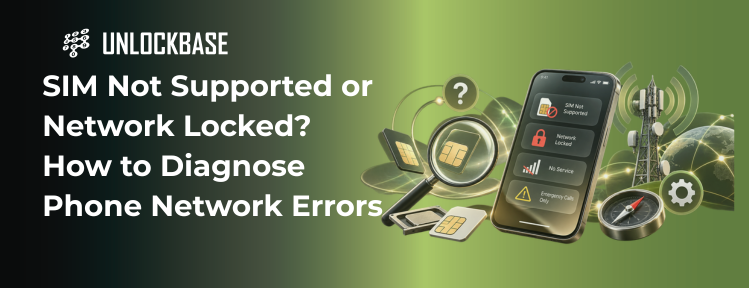
Seeing SIM not supported network locked messages—or suddenly finding that your phone has no mobile service—can immediately make it seem like the device needs unlocking. Sometimes that is exactly the problem. In other cases, however, the cause has nothing to do with a carrier lock.
A SIM problem, unsupported network bands, an inactive account, poor coverage, device configuration, or an IMEI-related restriction can produce similar symptoms. The wording also varies between manufacturers and operating systems, making diagnosis even more confusing.
Before ordering an unlocking service, it makes sense to identify what the phone is actually telling you. A few simple checks can separate a genuine carrier lock from problems that require a completely different solution.
Similar Messages Can Mean Very Different Problems
Mobile phones communicate network problems through short system messages. Unfortunately, those messages do not always explain the underlying cause clearly.
“SIM Not Supported,” “Network Locked,” “No Service,” and “Emergency Calls Only” may all appear when a phone cannot establish normal cellular service. Yet they describe different situations.
A true carrier lock error usually occurs because the phone is restricted to a particular carrier or network. When a SIM or eSIM from another provider is introduced, the device refuses normal activation.
Other errors occur after the phone has already accepted the SIM. In those cases, the device may simply be unable to register on the available network.
The first question, therefore, should not be “How do I unlock this phone?” It should be “Why is this phone unable to connect?”
“SIM Not Supported”: What It Usually Means
A SIM not supported message is one of the stronger indications that a carrier restriction may exist.
On an iPhone, for example, Apple explains that an unlocked device should show “No SIM restrictions” under Settings > General > About > Carrier Lock on supported iOS versions. If another carrier’s SIM cannot activate and the device remains carrier-locked, the original carrier normally controls eligibility for the unlock.
However, “SIM Not Supported” still deserves investigation before you assume the cause.
The SIM itself could be inactive, damaged, or incorrectly provisioned. An eSIM profile may also fail because the carrier does not support that particular device variant.
Start by checking three things:
Does the SIM work in another compatible phone?
Does the phone accept a SIM from its original carrier?
Does the device’s lock-status information show a carrier restriction?
If the original carrier works but another compatible carrier does not, a network lock becomes a much stronger possibility.
“Network Locked” or “SIM Network Unlock PIN”: What It Means
Android devices often make carrier restrictions more explicit.
Messages such as “Network Locked,” “SIM Network Unlock PIN,” or a similar network unlock message commonly appear when a device recognizes a SIM from another provider but is restricted from using that network.
This is different from your normal SIM PIN.
A SIM PIN protects the SIM card itself. A SIM network unlock code or network unlock prompt relates to the phone’s carrier restriction. Entering your SIM PIN will not remove that restriction.
Avoid guessing codes repeatedly. Some devices limit the number of incorrect attempts and may eventually require additional assistance.
Instead, identify the phone’s exact model and original carrier. Then confirm whether the device qualifies for the carrier’s official unlocking process or whether an appropriate professional unlocking option exists.
“No Service” Doesn’t Automatically Mean Your Phone Is Locked
A phone says no service for many reasons, and a carrier lock is only one possibility.
In fact, if the phone accepts the SIM without displaying any lock-related warning, you should investigate ordinary connectivity issues before assuming that unlocking will help.
“No Service” can result from:
Weak or unavailable network coverage
An inactive SIM or eSIM
Incorrect network configuration
Temporary carrier outages
Unsupported cellular bands
Account or provisioning problems
An IMEI-related restriction
Try restarting the phone and toggling Airplane Mode before moving to more involved checks. Make sure the SIM or eSIM line is enabled and verify that the carrier account remains active.
If possible, test the SIM in another compatible device. If the second phone also has no service, the problem probably lies with the SIM, account, or network rather than the original phone’s lock status.
Network compatibility also matters, especially with imported devices. An unlocked phone is not automatically compatible with every carrier.
“Emergency Calls Only”: Lock Issue or Network Issue?
“Emergency Calls Only” means the phone can detect cellular infrastructure but cannot register for normal service.
That can happen with a carrier-locked phone, but it can also occur when the SIM is inactive, the account has a problem, coverage is limited, or the device cannot properly connect to the carrier.
This distinction becomes particularly important when traveling.
A phone purchased in one country may be fully unlocked yet lack important frequency bands used by a network in another region. Likewise, a carrier may require specific support for technologies such as VoLTE before allowing normal service.
If the device previously worked with the same carrier and suddenly displays “Emergency Calls Only,” investigate the network, SIM, and account first. A carrier lock generally does not appear spontaneously on a phone that was already operating normally as an unlocked device.
How to Determine Whether Unlocking Is Actually the Solution
When dealing with SIM not supported network locked errors, a systematic diagnosis is faster than trying random fixes. Work through the following checks before ordering any service.
1. Confirm the Carrier Lock Status
Start with the phone itself.
On compatible iPhones, open Settings > General > About and look for Carrier Lock. “No SIM restrictions” indicates that the iPhone is not carrier-locked.
Android menus vary by manufacturer and carrier, so there may not be an equally universal status field. Testing a known-working SIM from another compatible carrier can often provide useful evidence.
2. Check the SIM or eSIM
A faulty SIM can make a perfectly functional unlocked phone look like it has a network problem.
Confirm that the SIM is active and correctly installed. For eSIM, make sure the profile has been properly downloaded and activated.
When possible, test the SIM in another compatible device. You can also test a known-working SIM in the problem phone.
These two tests help separate a device issue from a SIM or account issue.
3. Verify Network Compatibility
Unlocking removes a carrier restriction. It does not add missing hardware capabilities.
Check whether the exact phone model supports the frequencies and network technologies used by your intended carrier. This is especially important for devices purchased abroad.
Two versions of the same smartphone can look identical while supporting different network configurations.
4. Check IMEI and Device Status
The IMEI identifies the handset on mobile networks. A phone may be unlocked while still facing restrictions because of its device status.
For example, a device reported lost or stolen may appear on a blacklist. Certain carriers may also restrict devices because of account or financing issues, depending on their policies.
A network unlock does not automatically resolve an IMEI blacklist. These are separate issues and should not be confused.
5. Identify the Original Carrier
If the phone really is locked, you need to know which carrier imposed the restriction.
This becomes particularly important with second-hand or refurbished devices. The current owner may have purchased the phone from a reseller and know little about its original network.
The model number, purchase records, carrier information, or a reliable device-status check can help establish the phone’s history.
Identifying the cause before ordering a service saves time and helps ensure that an unlock—not a SIM, compatibility, or network fix—is actually what your device needs.
When to Request an Unlock—and When Not To
Unlocking is the appropriate solution when a confirmed carrier restriction prevents an otherwise compatible device from using another network.
For example, imagine a phone that works normally with Carrier A. You insert an active SIM from compatible Carrier B, and the device displays “Network Locked” or requests a network unlock code. If the phone’s status confirms a carrier restriction, an unlock is the logical next step.
You probably do not need an unlocking service when the phone already shows that it has no SIM restrictions but still cannot connect.
In that situation, investigate:
SIM or eSIM activation
Network coverage
Carrier account status
Device compatibility
APN or network configuration
IMEI status
Temporary carrier outages
The same principle applies to international use. If an unlocked phone lacks the necessary network bands for a particular carrier, another unlock cannot create that compatibility.
Understanding this distinction prevents unnecessary orders and helps users focus on the actual source of the problem.
A Simple Diagnosis Can Save a Lot of Frustration
Network errors can look similar on the screen, but their solutions can be completely different.
“SIM Not Supported” and “Network Locked” often justify checking for carrier restrictions. “No Service” and “Emergency Calls Only,” meanwhile, require a broader diagnosis because they can result from SIM, coverage, compatibility, account, or device-status problems.
The key is to confirm the cause rather than treating every connectivity problem as an unlocking problem.
Check the carrier lock status, test the SIM, verify network compatibility, review the IMEI status, and identify the original carrier. Once those pieces are clear, you can determine whether unlocking is actually necessary.
If a carrier restriction is the cause, UnlockBase.com provides professional unlocking services for a wide range of devices and networks, with clear service information before you order.
All products, and company names, logos, and service marks (collectively the "Trademarks") displayed are registered® and/or unregistered
trademarks™ of their respective owners.
The authors of this web site are not sponsored by or affiliated with any of the third-party trade mark or third-party registered trade mark owners,
and make no representations about them, their owners, their products or services.
When using a professional unlocking service, it is reasonable to ask what phone unlocking personal information is actually required. Unlocking a device should involve enough information to identify the phone and process the request, but it should not require unlimited access to your private accounts or sensitive credentials.
This distinction matters because users often assume that any information requested by a service must be necessary. In reality, legitimate unlocking usually depends on a relatively small set of technical details, while passwords and financial credentials are generally unrelated to the process.
Understanding what a trustworthy provider needs—and what it does not—can help users protect their privacy while still completing an unlock successfully.
Why Unlocking Requires Device Information—but Not Unlimited Access
Phone unlocking is a technical process tied to the device, its carrier, and its network status.
That means a service may need identifying details about the phone itself. These details help match the correct service to the correct device and prevent errors.
However, unlocking typically does not require broad access to personal accounts.
A professional provider should be able to explain why each requested detail is needed. If that explanation is unclear, users should pause before submitting sensitive information.
The goal of safe phone unlocking is not only to complete the unlock, but also to minimize unnecessary data exposure.
Information Commonly Required for a Legitimate Unlock
The exact requirements vary by device and carrier, but most legitimate services ask for a predictable set of details.
Device Model
The exact phone model is important because unlocking methods can differ between devices.
For example, two phones from the same manufacturer may use different unlocking procedures if they were released for different regions or carriers.
Providing the correct model reduces the risk of ordering the wrong service.
IMEI
The IMEI, or International Mobile Equipment Identity, is one of the most commonly requested details.
It acts as a unique identifier for the device and allows the unlocking service to check the phone against carrier or manufacturer systems.
Because the IMEI identifies the device rather than the user, it is usually a normal part of the process.
That said, IMEI privacy still matters. Users should share the number only with reputable services and avoid posting it publicly.
Carrier
Unlocking depends heavily on the original carrier.
A phone locked to one network may require a different process from the same model locked to another.
This is why legitimate services usually ask which carrier originally sold or locked the device.
Country or Network Information
Some services also require the country of purchase or the regional network.
This matters because carriers can use different systems or policies across markets.
These details are practical and directly related to the unlock.
Sensitive Information You Should Treat With Caution
A legitimate unlocking service should not require access to unrelated personal accounts.
Certain requests deserve particular caution.
Account Passwords
Your account passwords are generally not necessary for carrier unlocking.
If a service asks for a password, it should clearly explain why. In most cases, an unlocking service password request should be treated with caution.
Apple ID Credentials
Carrier unlocking does not normally require your Apple ID password.
Apple ID credentials control personal data, purchases, backups, photos, and device security features. They are highly sensitive and should not be shared unless you are working directly within Apple’s own secure account systems.
Google Account Credentials
The same principle applies to Google account passwords.
Unlocking a carrier restriction does not usually require access to Gmail, Google Drive, photos, contacts, or other account data.
Banking or Payment Credentials
A service may need payment information to process an order, but it should never ask for unrelated banking passwords, PINs, or online banking credentials.
Payment should happen through a normal secure checkout process.
Unnecessary Personal Documents
In some cases, identity verification may be required by a carrier or specific regulatory process. However, a provider should explain why any personal document is needed.
Uploading identification without a clear reason creates unnecessary privacy risk.
Why the Requested Information Depends on the Unlock Method
Not every unlock uses the same process.
Some rely primarily on IMEI-based carrier database updates. Others may involve device-specific steps or carrier approval.
Because of this, the information required can vary.
An IMEI-based method may only need:
Device model
IMEI
Original carrier
Country or network details
A more complex process may require additional confirmation, but the provider should always connect the requested information to the actual method.
This is an important part of phone unlock privacy.
The user should understand what the data is for rather than simply being asked to trust the process blindly.
Red Flags When a Service Requests More Than It Needs
One of the easiest ways to evaluate a provider is to compare the information requested with the service being offered.
A few warning signs include:
Asking for Apple ID or Google passwords without a clear reason
Requesting banking credentials outside a normal payment flow
Demanding remote account access
Asking for unrelated personal documents
Refusing to explain why sensitive information is needed
A legitimate unlocking service should be able to justify each requirement.
When a request feels unrelated to the actual unlock, users should ask questions before proceeding.
Before submitting sensitive information, make sure you understand why it is required and whether it is genuinely relevant to the unlocking method being used.
Transparency Is Part of a Professional Unlocking Service
Good unlock service security starts with transparency.
A professional provider should make the process understandable before the customer submits an order.
That means clearly explaining:
What information is required
Why it is required
How it will be used
What information is not needed
What happens after submission
This level of clarity builds trust and reduces uncertainty.
It also helps users distinguish between normal technical requirements and unnecessary access requests.
A service that communicates clearly about its process is easier to evaluate than one that hides behind vague claims.
How to Protect Your Data Before Ordering
Users can take several simple steps to reduce risk.
First, review the provider’s requirements before submitting anything.
Second, avoid reusing passwords or sharing account credentials.
Third, never post your IMEI publicly on forums or social media.
Fourth, use secure payment methods and avoid sending financial information through informal channels.
Finally, ask questions when a request seems unusual.
A reputable provider should be comfortable explaining why information is needed.
Why Privacy Matters More in 2026
Phones now contain far more personal data than they did a few years ago.
Email, banking apps, authentication tools, private photos, work documents, and cloud accounts all live on the same device.
That makes unnecessary access especially risky.
As unlocking services become more common, users should expect stronger transparency standards.
The best providers minimize the amount of phone unlocking personal information they request and keep the process focused on the device rather than the owner’s broader digital life.
Conclusion
Understanding what a phone unlocking service really needs is an important part of protecting your data.
In most cases, legitimate unlocking depends on technical information such as the device model, IMEI, carrier, and region. Sensitive credentials such as Apple ID passwords, Google account passwords, and banking access should not be treated as routine requirements.
By understanding the difference between necessary device details and unrelated personal information, users can make safer decisions and choose providers with greater confidence.
UnlockBase.com focuses on transparent unlocking processes, clearly identifying the device information required for each service so customers know what to expect before ordering.
All products, and company names, logos, and service marks (collectively the "Trademarks") displayed are registered® and/or unregistered
trademarks™ of their respective owners.
The authors of this web site are not sponsored by or affiliated with any of the third-party trade mark or third-party registered trade mark owners,
and make no representations about them, their owners, their products or services.
If you plan to unlock phone for family member use, it is worth checking the device before simply handing it over. Passing an older smartphone to a child, parent, partner, or relative is a practical way to save money and extend the useful life of a device, but carrier restrictions can create problems if the next user is on a different network.
A phone may look fully ready for its new owner and still fail during activation because of a carrier lock, an unresolved account issue, or a compatibility limitation.
A few checks before the handover can make the transition much smoother and prevent the new user from discovering unexpected restrictions later.
Why More Families Pass Smartphones Between Generations
Modern smartphones last longer than they used to. Better processors, stronger materials, longer software support, and improved battery management mean that a device can remain useful well after its original owner decides to upgrade.
That makes the hand-me-down smartphone increasingly common.
A parent may buy a new flagship and pass the previous model to a teenager. An adult child may give an older phone to a parent. Partners may swap devices based on storage, size, or camera preferences.
This approach offers several practical advantages. Families reduce the cost of purchasing another phone, avoid wasting usable hardware, and often give a reliable device a second life.
The process also makes sense environmentally. Reusing an existing phone usually extends its lifecycle more effectively than replacing it simply because a newer model is available.
However, the new user may not have the same carrier, account, or connectivity needs as the previous owner. That is where network restrictions become important.
The Problem When the New User Has a Different Carrier
The most common issue appears when the original owner and the new user rely on different mobile providers.
A carrier-locked phone may work perfectly for the original owner because it remains on the network for which it was configured. The problem only becomes visible when someone inserts another carrier’s SIM card or attempts to activate a different eSIM profile.
The device may then display a message indicating that the SIM is unsupported, refuse activation, or remain unable to register on the new network.
This can be confusing because nothing appears wrong with the phone itself.
The battery works. The screen works. Wi-Fi works. Apps launch normally.
The limitation comes from the carrier restriction rather than the hardware.
This is why families should check whether they need to unlock phone for family member use before the device changes hands.
Before passing a phone to someone else, checking its carrier status can prevent the new owner from discovering restrictions only after trying to activate it.
Case Study: Parent Upgrades, Child Gets the Previous Phone
A simple family scenario illustrates why preparation matters.
A parent upgrades from a two-year-old smartphone to a newer model. The old device remains in excellent condition, so the family decides to give it to a child instead of selling it.
Same Carrier Scenario
If both the parent and child use the same carrier, the transition may be relatively simple.
The family can remove the parent’s account, reset the device, install or activate the child’s SIM or eSIM, and complete the setup.
Even in this case, however, it still makes sense to confirm the device’s status. A future carrier switch could expose restrictions that do not matter today.
If the child later moves to another provider, studies abroad, or uses a travel eSIM, the lock may become relevant again.
Different Carrier Scenario
Now imagine the parent uses one major carrier while the child is on a lower-cost MVNO or a different national network.
The phone may be physically compatible with the new provider yet still reject activation because it remains carrier locked.
That turns what looked like a simple handover into an unexpected problem.
At this point, the family needs to confirm whether the device is eligible for unlocking and whether any remaining obligations must be resolved first.
The example shows why users who give old phone to family members should think about carrier status before wiping the device and passing it on.
What Should Be Checked Before Handing Over the Device
Preparing a phone for another owner involves more than deleting photos and removing the case.
Several checks help ensure the next user can activate and use the device without trouble.
Lock Status
Start by confirming whether the phone is carrier locked.
On many iPhones, users can check this under:
Settings → General → About → Carrier Lock
If the device shows “No SIM restrictions,” it is generally unlocked.
On Android, the exact process varies by manufacturer and carrier. In some cases, the easiest confirmation is to test the phone with a SIM from another compatible network or contact the original carrier.
Outstanding Device Obligations
A phone may remain tied to financing, installment agreements, or other account conditions.
Before attempting to transfer phone to another person, confirm that any applicable carrier obligations have been completed.
This is important because some carriers will not approve an unlock until the device meets their eligibility requirements.
Account Removal
The original owner’s personal accounts should be removed before the handover.
For iPhone users, that includes signing out of the Apple Account and turning off Find My.
Android users should remove their Google account and any manufacturer-specific accounts before performing a factory reset.
This step protects the original owner’s personal information and prevents activation-lock issues for the new user.
Compatibility
An unlocked phone still needs to be technically compatible with the new carrier.
Check whether the device supports the required network bands, eSIM standards, VoLTE, and other services used by the new provider.
This is especially important with phones originally purchased in another country or region.
Unlocking vs Transferring Ownership: Understanding the Difference
Those two processes solve different problems.
Unlocking removes the carrier restriction that limits which compatible networks the phone can use.
Transferring ownership involves preparing the device so another person can take control of it.
That usually includes:
Removing personal accounts
Backing up and deleting personal data
Resetting the device
Transferring any applicable warranty or documentation
Providing the new owner with the necessary setup information
A phone can be fully reset and transferred while still remaining carrier locked.
Likewise, an unlocked phone can still contain the previous owner’s accounts if the handover was not completed properly.
Understanding this distinction is essential when preparing a carrier locked family phone for someone else.
Both steps may be necessary, but they address completely different parts of the transition.
Making a Used Device Ready for Its Next Owner
Once lock status, account obligations, and compatibility are confirmed, the final preparation becomes straightforward.
Start by backing up anything you want to keep. Photos, contacts, messages, documents, and app data should be transferred before the device is erased.
Next, remove all personal accounts and disable any device-tracking or activation-lock features.
After that, perform a factory reset and allow the phone to return to its original setup screen.
It is also worth cleaning the device, checking battery health, and making sure accessories such as the charger are included if available.
Before handing it over, test the phone with the new user’s SIM or eSIM if possible.
This simple step confirms that the device is actually ready for service rather than merely appearing ready.
Why Unlocking Can Extend a Phone’s Useful Life
The ability to reuse old phone hardware depends heavily on flexibility.
A phone that remains restricted to one carrier may still have plenty of technical life left, yet become inconvenient as family members change providers or move between regions.
Unlocking can help separate the lifespan of the device from the original carrier relationship.
That means the same phone may continue serving different users across several years.
For families, this can reduce replacement costs and make device handovers more practical.
It can also increase resale value later if the family eventually decides to sell the phone rather than pass it on again.
In this sense, the decision to unlock phone for family member use can support both immediate convenience and long-term value.
Common Mistakes Families Should Avoid
Most problems during device handovers come from skipped checks rather than complicated technical issues.
One common mistake is assuming that a factory reset automatically removes the carrier lock. It does not.
Another is assuming that a phone will work simply because the new carrier uses similar network technology.
Users should also avoid handing over a device before removing the original owner’s Apple or Google account. Doing so can create activation problems that have nothing to do with carrier status.
Finally, do not rely solely on the seller, carrier, or previous user saying that a device “should work.”
Whenever possible, verify the lock status and test the phone on the intended network.
Conclusion
Passing an older smartphone to a family member is one of the smartest ways to extend a device’s useful life. It saves money, reduces waste, and gives a still-capable phone another purpose.
However, a smooth handover requires more than wiping the data.
Families should confirm carrier lock status, check outstanding obligations, remove personal accounts, and verify compatibility with the new user’s network.
If the device remains tied to its original carrier, taking steps to unlock phone for family member use can prevent activation problems and give the next owner much more flexibility.
UnlockBase.com helps families give existing devices a useful second life by providing professional unlocking solutions when carrier restrictions stand in the way.
All products, and company names, logos, and service marks (collectively the "Trademarks") displayed are registered® and/or unregistered
trademarks™ of their respective owners.
The authors of this web site are not sponsored by or affiliated with any of the third-party trade mark or third-party registered trade mark owners,
and make no representations about them, their owners, their products or services.